

Stacking Rings and Bracelets: Balance Without Overdoing It
You spent twenty minutes piling rings onto every finger and clasping bracelet after bracelet, and the mirror gave you back something that reads as cluttered rather than curated. The pieces are beautiful on their own. Together they fight for attention, tangle at the wrist, and lose the easy confidence you were after. That gap between "a lot of jewelry" and "a considered stack" is the whole game, and it comes down to a handful of principles the best stylists lean on every single time.
Learning how to stack rings and bracelets is less about owning more and more about arranging what you have with intention. Below is the full method: the balance rules, the metal-mixing math, the wrist logic that keeps a watch and three bracelets from becoming a jangling mess, plus a formula table you can copy tomorrow morning.
How to Stack Rings and Bracelets Without Looking Cluttered
The secret to stacking rings and bracelets is contrast within cohesion: keep one unifying thread (a shared metal tone or style family) while varying widths, textures, and heights so each piece reads as distinct. Anchor the arrangement with one statement piece, favor odd numbers, and always leave negative space so the eye has somewhere to rest.
Everything else is a variation on that idea. A stack fails when every piece is the same weight and finish, because the eye can't separate them and the whole thing blurs into a solid band of metal. It also fails at the opposite extreme, when five loud, competing pieces all shout at once. The curated look lives in the middle, where similarity and difference are held in tension on purpose.
Think of it the way you'd think of getting dressed. You wouldn't wear five identical layers, and you wouldn't wear five clashing prints. You'd pick a base, add contrast, and edit until it feels intentional. Your wrists and fingers deserve the same editing eye.
Start With an Anchor Piece
Every strong stack begins with one anchor: the most substantial or eye-catching piece that sets the tone for everything around it. On the wrist, that anchor is often a watch. On the hand, it might be a signet, a wide band, or a ring with a central stone. Choose it first, then build the rest of the arrangement in conversation with it.
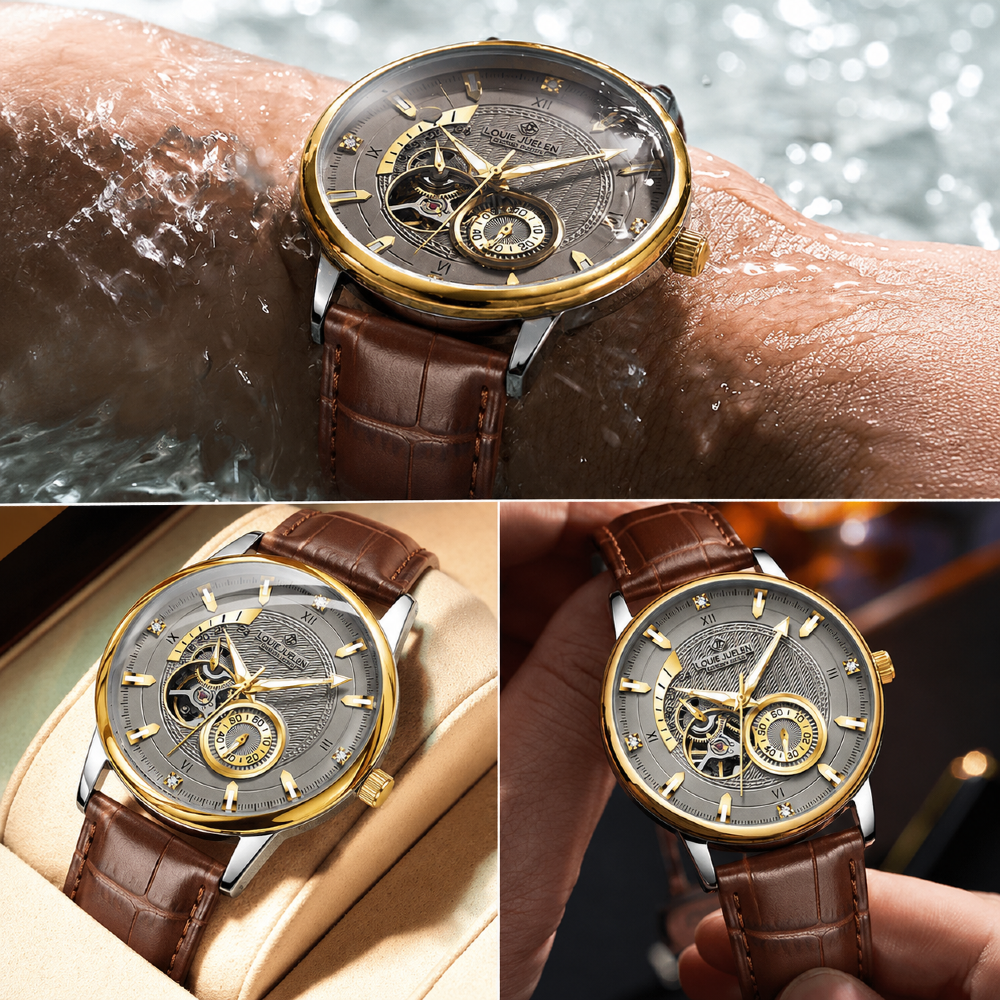
The anchor does two jobs. It gives the eye a clear focal point so the stack has a visual center of gravity, and it dictates the metal and mood of the supporting cast. A warm yellow-gold watch invites gold-toned bracelets and a mix of textures that echo its finish. A cool, architectural statement ring wants slimmer bands that support rather than compete.
Once the anchor is chosen, resist the urge to add a second showstopper right beside it. Two voluminous pieces on adjacent fingers, or two chunky cuffs side by side, hinder each other and read as cluttered. Alternate instead: statement piece, then a bare finger or a thin band, then the next moment of interest.
Vary Widths, Textures, and Heights
The most interesting ring and bracelet stacks combine different widths and textures so each piece registers separately. Pair one wider band with thinner accent bands; combine a polished bangle, a woven or beaded strand, and a fine chain. That deliberate variation creates visual rhythm, guiding the eye from one element to the next instead of letting them dissolve into a uniform block.
Width is the easiest lever to pull. A thin, a medium, and a wide band stacked on one finger already look composed, because the differing proportions do the work. If every ring is the same slim width, add a chunkier band to break the monotony; if everything is bold, slip in a delicate band to give the eye relief.
Texture is the next lever, and it is what separates a good stack from a flat one. A high-polish surface next to a hammered or matte one catches light differently across the two, adding depth. On the wrist, a chain, a beaded strand, and a smooth cuff worn together read as styled precisely because the materials differ. Mixing finishes intentionally is how a small number of pieces can look rich rather than repetitive.
Balance Odd Numbers and Both Hands
Odd numbers tend to look more dynamic and intentional than even ones, which is why three rings or five bracelets so often feel naturally balanced. For most fingers and wrists, three to five pieces is the sweet spot: full enough to look considered, restrained enough to avoid crowding.
Balance across both hands, not within a single overloaded one. Big statement rings need room to breathe, so let one hand carry the bold moment and the other carry a quieter pairing of thin bands. Experiment with an uneven number of fingers overall, say three or five out of ten, and keep at least one finger bare on each hand. That restraint is what makes the jewelry you do wear look chosen.
Mixing Metals in a Stack the Right Way
Mixing metals works when you let one tone dominate: use roughly 60 to 70 percent of your dominant metal, around 30 percent of a secondary tone, and up to 10 percent as an accent. This dominant-and-supporting ratio keeps a gold-and-silver stack from looking accidental and gives it a clear visual hierarchy instead.
Pick the dominant tone first, usually whatever you wear most or whatever flatters your skin. Then layer in the secondary metal deliberately rather than scattering it. Stylists call the clustering trick keeping mixed tones close together rather than spreading them thin, so the contrast reads as a decision. A two-tone ring or a plain spacer band can bridge a bold jump between gold and silver and make the transition feel seamless.
Two guardrails keep metal-mixing polished. Stick to two or three tones total, because more starts to feel busy. And repeat each tone at least once across the look, so a silver ring finds an echo in a silver bracelet or earring. Textural variety helps the tones marry, too: a matte yellow-gold band beside a polished white-gold one ties the colors together through finish.
Bracelet Stacking With a Watch: Building the Arm Party
For a bracelet stack with a watch, treat the timepiece as your anchor and aim for three to five pieces total including the watch. Place the watch as the grounding focal point, add bracelets that vary in texture, and stagger their tightness so they sit at slightly different heights on the arm rather than clashing at one point.
The arm party lives or dies on how you manage tangling. The fix is weight, order, and length. Vary how snugly each piece sits so they rest at different levels instead of colliding. Sandwich your finest, lightest chain between two heavier pieces, letting a thicker chain and a cuff act as guardrails that stop the delicate strand from twisting. Uniform lengths tangle; staggered lengths drape.
Around a watch specifically, keep thin bracelets on the same wrist positioned so they don't fight the watch band, and consider a balanced arrangement with a piece or two on either side of the case for symmetry. The watch supplies the sophistication and structure; the bracelets add texture, color, and a sense of personal collection. Mix a chain, a beaded strand, and a cord and the trio reads as intentional every time.
Stacking Formulas at a Glance
Use these tested combinations as starting points, then adjust to your own pieces. Each is built on an anchor, deliberate contrast, and breathing room.
| Look | Anchor Piece | Supporting Pieces | Metal Ratio | Best For |
|---|---|---|---|---|
| Everyday minimalist | One medium band | Two thin bands, varied texture | Single tone | Work, low-key days |
| Classic ring stack | Wide statement ring | Two slim bands on other fingers | 70/30 dominant + accent | Balanced daytime polish |
| Mixed-metal edit | Two-tone ring | One gold, one silver band, clustered | 60/30/10 | Modern, fashion-forward |
| Arm party (no watch) | Chunky cuff | Beaded strand + fine chain + bangle | Two tones max | Events, weekends |
| Watch arm party | The watch | One or two thin bracelets per side | Match watch tone | Elevated everyday |
| Statement + rest | One bold cocktail ring | Bare adjacent fingers, one thin band | Single tone | Evening, photos |
The through-line across every row is the same trio: anchor, contrast, negative space. Once those three habits are automatic, you can improvise with confidence.
Leave Negative Space So the Stack Can Breathe
Negative space is what makes a stack feel intentional instead of overloaded. Leave at least one finger bare when you stack across the hand, and allow a little room between rings on a single finger, especially when you're mixing widths, textures, or stone settings. That breathing room gives the eye a place to rest and lets each piece register.
It's the most counterintuitive rule and the most important one. When a stack looks cluttered, the instinct is often to rearrange or add a piece that "pulls it together." Usually the fix is subtraction. Remove one ring, free up one finger, loosen one bracelet, and the whole arrangement snaps into focus.
Comfort belongs in this conversation too. Rings that sit too tight can pinch circulation, and bracelets crammed at one point of the wrist will never drape well. If a stack hurts or won't stop twisting, that's information: edit it down until it feels as good as it looks.
Frequently Asked Questions
How many rings and bracelets should I wear at once?
Aim for three to five pieces per stack, whether on a hand or a wrist, and keep to a maximum of two or three rings per hand. Balance across both hands rather than loading one, and leave at least one finger bare. Odd numbers of pieces and fingers tend to look the most intentional.
Can you mix gold and silver when stacking rings and bracelets?
Yes, and it looks deliberately modern when you let one metal dominate. Use roughly 60 to 70 percent of your main tone, add a secondary tone, and keep an accent to around 10 percent. Cluster the mixed tones close together, repeat each tone at least once across the look, and use a two-tone or spacer piece to bridge the shift.
How do I stack bracelets with a watch without them tangling?
Make the watch your anchor and vary the weight, length, and tightness of the bracelets around it. Sandwich a delicate chain between two heavier pieces so they act as guardrails, keep thin bracelets from crowding the watch band, and stagger how snugly each sits so they rest at different heights on your arm.
Why does my ring stack still look cluttered even when I follow the rules?
Cluttered usually means too little contrast or too little negative space. Check that your pieces vary in width and texture rather than repeating one look, confirm you haven't placed two bold pieces side by side, and remove one element to open up breathing room. Subtraction fixes an overcrowded stack far more often than addition.
Stacking rings and bracelets well is a skill, not a shopping list. Anchor the look, build contrast through width and texture, keep your metals in a clear ratio, and protect the empty space that lets it all read as curated. Do that, and a handful of well-chosen pieces will always outshine a wrist full of competing ones.