

How to Read a Tachymeter: A Watch Expert's Simple Guide
You strap on a handsome chronograph, admire the busy dial, and then notice it: a ring of numbers running around the outer edge, descending in a strange rhythm from 500 down to 60. Most owners never touch it. They assume it is decoration, or a puzzle meant for engineers and race drivers. It is neither. That ring is a tachymeter, and once you understand the single idea behind it, you can read speed straight off your wrist without a calculator, an app, or a second glance.
This guide breaks down exactly how to read a tachymeter, the simple formula that powers it, the worked math behind a real example, and the honest limits of what it can and cannot do.
What Is a Tachymeter, Really?
A tachymeter is a fixed scale printed around the rim of an analog chronograph watch that converts an elapsed time in seconds into a rate expressed in units per hour. It does not measure speed on its own. It works together with the chronograph's sweeping seconds hand to translate how long something took into how often it would happen in one hour.
That distinction matters. The tachymeter scale is a pre-calculated ruler, nothing more. All the "work" was done at the factory when the numbers were laid out. Your job is simply to run the chronograph over a known distance, stop it, and read where the hand lands. The scale has already done the division for you.
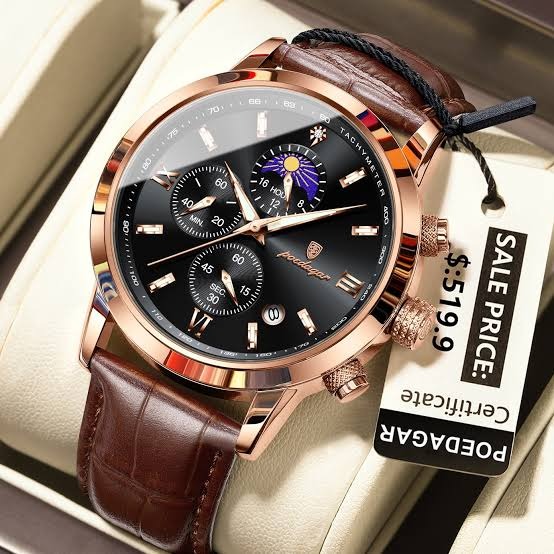
You will usually find the tachymeter in one of two places: engraved on the fixed bezel surrounding the dial, or printed on a flange (the sloped inner ring) just inside the crystal. Either way, the numbers typically start high near the 12 o'clock position, around 500 to 400, and sweep clockwise down to about 60 at the bottom. That descending run is not random. It is the visible fingerprint of the math underneath.
The Tachymeter Formula: Units Per Hour Made Simple
Every standard tachymeter scale is built from one equation: T = 3600 divided by t, where T is the tachymeter reading in units per hour and t is the elapsed time in seconds. Because there are 3,600 seconds in an hour, dividing that number by your measured seconds tells you how many times the event fits into sixty minutes.
Let that sink in, because it demystifies the whole complication. The number 3,600 is simply the count of seconds in one hour (60 seconds times 60 minutes). When you time an event and divide 3,600 by the seconds it took, you learn the hourly rate of that event. The scale on your watch is nothing more than that division, printed permanently around the dial so you never have to do it in your head.
A quick sanity check makes it click:
- An event that takes 60 seconds happens 60 times per hour, so the scale reads 60.
- An event that takes 30 seconds happens 120 times per hour, so the scale reads 120.
- An event that takes 45 seconds happens 80 times per hour, so the scale reads 80.
Notice what the formula does not care about: the unit of distance. A tachymeter is unit-agnostic. If you measured one mile, the reading is miles per hour. If you measured one kilometer, it is kilometers per hour. If you counted one part off a machine, it is parts per hour. The scale converts time to rate; you supply the meaning of the unit.
How to Read a Tachymeter Step by Step
To measure speed with a tachymeter, start the chronograph as you pass a known start point, stop timing your seconds hand exactly one measured unit of distance later, and read the number the seconds hand points to on the tachymeter scale. That number is your speed in units per hour.
Here is the full sequence, slowed down:
Step 1: Confirm Your Known Distance
The tachymeter needs a fixed, known distance to work. On a highway, the mile markers or kilometer posts are perfect, since they are spaced exactly one unit apart. You are going to measure the time it takes to travel that one unit.
Step 2: Start the Chronograph at the First Marker
The moment you pass your starting point, press the top pusher to launch the chronograph seconds hand from zero. Precision at the start matters more than anything else, because a late or early press throws off the entire reading.
Step 3: Stop Timing at the Second Marker
When you reach the end of your one measured unit, note where the seconds hand is. You do not even need to stop the watch; you simply read the tachymeter number sitting directly beneath the tip of the seconds hand at that instant.
Step 4: Read the Speed
The value on the tachymeter scale next to the seconds hand is your average speed for that distance, in units per hour. If you measured a mile, it is miles per hour. Cleanly done, no arithmetic required.
A Worked Example: Reading Speed on a Real Drive
Suppose you are driving a steady stretch of motorway and want to check your speed against your speedometer. You pass a kilometer post and start the chronograph. Exactly one kilometer later, at the next post, the sweeping seconds hand is pointing at 90 on the tachymeter scale.
That reading tells you that you were traveling 90 kilometers per hour, because covering one kilometer in that elapsed time works out to ninety of those kilometers in a full hour. Run the math to prove the scale honest: it took 40 seconds to cover the kilometer, and 3,600 divided by 40 equals 90. The scale and the formula agree perfectly.
The table below shows how elapsed time maps to the tachymeter reading across a typical range, so you can see the descending pattern that gives the scale its shape:
| Elapsed time over 1 unit | Formula (3600 ÷ t) | Tachymeter reads | Speed |
|---|---|---|---|
| 10 seconds | 3600 ÷ 10 | 360 | 360 units/hour |
| 15 seconds | 3600 ÷ 15 | 240 | 240 units/hour |
| 20 seconds | 3600 ÷ 20 | 180 | 180 units/hour |
| 30 seconds | 3600 ÷ 30 | 120 | 120 units/hour |
| 40 seconds | 3600 ÷ 40 | 90 | 90 units/hour |
| 45 seconds | 3600 ÷ 45 | 80 | 80 units/hour |
| 60 seconds | 3600 ÷ 60 | 60 | 60 units/hour |
Read the table from top to bottom and you can see why the numbers on the bezel crowd together near the top and spread out toward 60. Fast events over short seconds live in the compressed high end of the scale; slower events over longer seconds occupy the roomy low end.
The Honest Limits of the Tachymeter Scale
A tachymeter only works cleanly for events that finish in under sixty seconds, because once your measured unit takes longer than a minute the seconds hand has completed a full revolution and the reading falls off the bottom of the scale. In practice the scale is most usable and readable between roughly 7 and 60 seconds, which corresponds to speeds from about 500 down to 60 units per hour.
There are two other honest caveats worth stating plainly. First, very fast events that take fewer than about ten seconds land in the tightly packed top of the scale, where the markings are hard to resolve precisely, so your reading becomes an estimate rather than a clean number. Second, a tachymeter gives you an average over the measured distance, not an instantaneous speed. If your pace varied between the two markers, the scale reports the average of the whole run.
None of this makes the complication useless. It makes it a tool with a defined working range, like any good instrument. Stay inside 7 to 60 seconds and it is genuinely accurate.
Beyond Speed: Measuring Distance and Production Rate
The tachymeter's logic runs in more than one direction, which is what makes it quietly clever. Because it links time, distance, and rate, you can hold one of those constant and solve for another. Two uses beyond simple speed are worth knowing.
Measuring Distance at a Known Speed
If you already know your speed and hold it constant, the tachymeter can tell you when you have covered one unit of distance. Traveling at a steady 80 miles per hour, start the chronograph and watch the seconds hand: when it reaches the 80 mark on the scale (which happens at 45 seconds), you have traveled exactly one mile. Hold the same speed to the next time it hits 80, and that is a second mile. It turns your wrist into a rough odometer.
Measuring Production and Repetition Rate
This is where the tachymeter earned its keep in factories long before digital timers existed. Any repeating event can be rated per hour. Time one complete cycle of a stamping press, one unit coming off an assembly line, or one espresso pulled by a barista, and the number under the seconds hand tells you how many of those would happen in an hour at that pace. A machine that completes one part every 30 seconds reads 120 on the scale, meaning 120 parts per hour. Supervisors on production floors genuinely used this to spot-check output rates.
Frequently Asked Questions
How do I read a tachymeter if my event takes longer than 60 seconds?
You cannot read it directly, because the scale only covers events under one minute. The common workaround is to measure a fraction of the distance instead. Time a tenth of a mile rather than a full mile, read the scale, then multiply the result by ten. The formula still holds; you are just scaling the unit to keep the elapsed time inside the readable 7 to 60 second window.
Do I need to stop or reset the chronograph to read the tachymeter?
No. The tachymeter reading is taken at the instant the seconds hand reaches the end of your measured unit, so you simply glance at the number beneath the hand at that moment. Stopping the chronograph afterward just freezes the reading so you can note it comfortably, but the measurement itself is complete the second you finish the distance.
Can a tachymeter measure kilometers per hour and miles per hour on the same watch?
Yes, because the scale is unit-agnostic. The same tachymeter reads correctly in either system depending on the distance you choose to measure. Time one mile and the reading is miles per hour; time one kilometer and the identical number is kilometers per hour. The watch never needs to know which unit you picked, since the scale only ever converts seconds into rate.
Why do the numbers on a tachymeter get closer together near the top?
Because the relationship between time and rate is not linear. The scale is built on 3,600 divided by seconds, so small changes in a short elapsed time produce large jumps in the reading. A one-second difference at the fast end swings the value far more than a one-second difference at the slow end, which is why the high numbers crowd together and the low numbers spread out.
Bringing It to Your Wrist
A tachymeter rewards the small effort it takes to learn it. Once you internalize the single idea, that 3,600 divided by your seconds equals your rate, the scale stops being a mystery ring and becomes a genuinely useful instrument for speed, distance, and repetition. It is one of the most satisfying details on a fine chronograph precisely because so few people bother to understand it, and now you are not one of them.