

Automatic vs Quartz Watches: Which Should You Buy?
Buying a watch is rarely about telling the time anymore. Your phone does that. What you are really choosing is a small mechanical character that lives on your wrist for years, maybe decades. That choice almost always comes down to two movements: automatic or quartz. One breathes with the motion of your body and asks to be cared for. The other is quietly, ruthlessly precise and asks almost nothing of you. Neither is "better" in a vacuum. The right answer depends on how you live, what you value, and how much fuss you actually want. Let's settle the automatic vs quartz watches debate with honest, expert guidance rather than snobbery.
Automatic vs Quartz Watches: The Short Answer
Automatic watches are self-winding mechanical timepieces powered by the motion of your wrist, prized for craftsmanship and heirloom longevity. Quartz watches run on a battery and a vibrating quartz crystal, making them far more accurate, lower maintenance, and usually more affordable. Choose automatic for soul and tradition, quartz for precision and convenience.
That is the headline. The detail is where the decision actually gets made, so let's open up both movements and see what you are really buying.
How an Automatic Watch Works
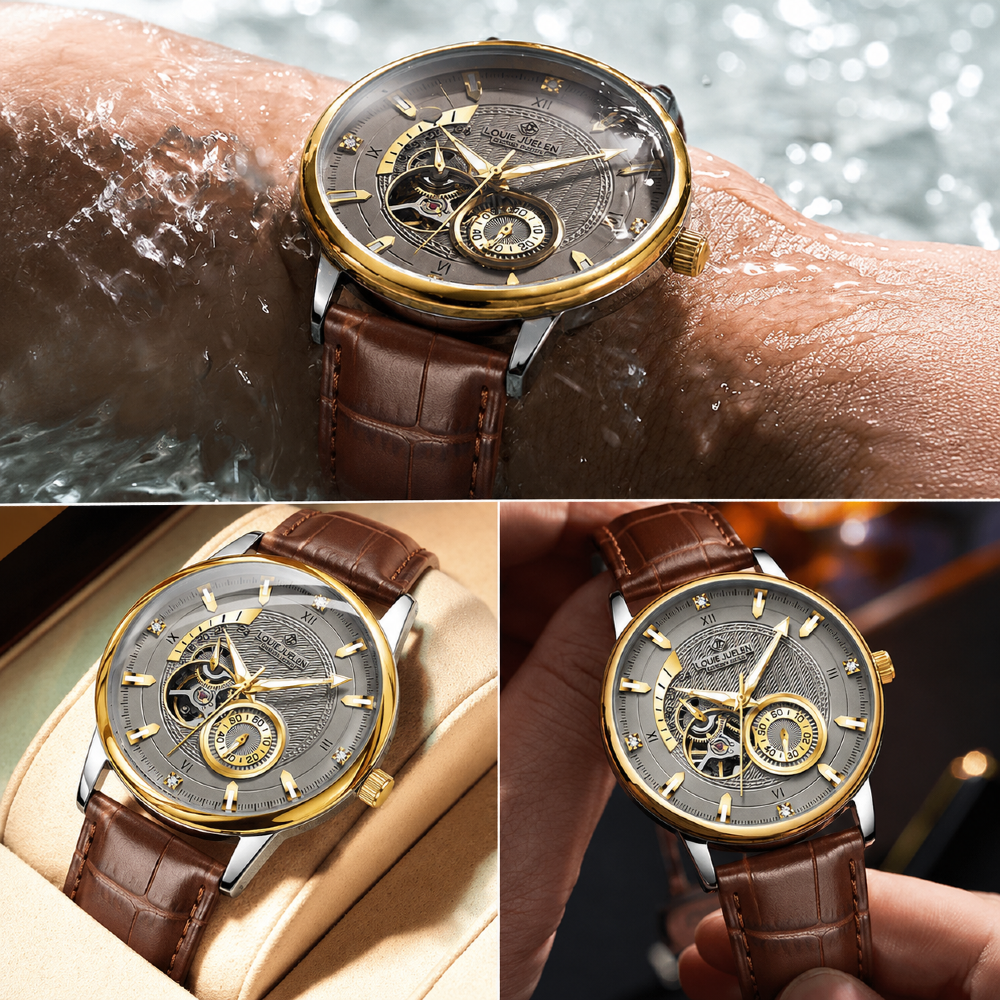
An automatic watch is a tiny mechanical engine that winds itself from your everyday movement. At its heart sits a mainspring, a coiled band of spring steel that stores energy. A weighted rotor swings freely as your wrist moves, and that motion winds the mainspring, which then releases its energy through a gear train to drive the hands.
There is no battery anywhere in the mechanism. The rotor is the signature of the automatic movement, a semicircular metal weight that pivots with the smallest gesture, from typing to walking to reaching for a coffee. Wind a watch by wearing it, and it keeps time on its own. Leave it on the nightstand and it slowly runs out of stored energy, which brings us to power reserve.
Power Reserve: What Happens When You Take It Off
Power reserve is how long an automatic watch keeps running once you stop wearing it. Most automatic watches hold between 36 and 42 hours, though many modern calibers now stretch to 70 or even 80 hours on a full wind. Take the watch off Friday evening and a 40-hour reserve may leave it stopped by Sunday.
This is the quiet trade-off of automatics. If you rotate between several watches, expect to reset the time and date on any that have sat idle. A longer power reserve, or a watch winder, softens that inconvenience without eliminating it.
How a Quartz Watch Works
A quartz watch keeps time using a battery and a sliver of quartz crystal. Current from the battery passes through the crystal, which vibrates at a remarkably steady 32,768 times per second. An integrated circuit counts those vibrations and sends a pulse once per second to a stepping motor, which advances the hands.
That relentless, unchanging frequency is the whole secret. Because the crystal oscillates at the same rate regardless of whether you are moving, sleeping, or sitting still, a quartz watch does not care about your activity level the way an automatic does. It simply ticks, second by second, until the battery runs low.
Do Quartz Watches Need Batteries?
Yes. A quartz watch depends on a small battery, typically lasting two to five years before it needs replacing. Battery swaps are inexpensive and quick, usually handled in minutes by any watchmaker or jeweler, and often paired with a fresh water-resistance seal check.
The battery is the only real running cost of a quartz watch, and it is a modest one. There is no rotor to wind, no reserve to monitor, and no ritual to remember.
Shop Automatic & Quartz Watches →
Quartz vs Automatic Accuracy: The Gap Is Real
On pure accuracy, quartz wins decisively. A standard quartz watch keeps time to within roughly half a second per day, often quoted as about 15 seconds per month. A typical automatic drifts 10 to 20 seconds every single day, which makes quartz dramatically more precise for real-world timekeeping.
The numbers deserve context. A well-regulated automatic can reach 4 to 6 seconds per day, and COSC-certified chronometers are held to a strict standard of minus 4 to plus 6 seconds per day. Even so, that is per day, while quartz is measured per month. High-accuracy quartz movements push the gap further, with the best calibers rated to just a few seconds per year.
Automatic accuracy also shifts with real-life factors: how the watch is resting overnight, temperature, magnetism, and how recently it was serviced. If you are the type who is bothered by a watch that runs a minute fast by week's end, quartz is the honest recommendation. If a small drift feels like a living quirk rather than a flaw, an automatic will charm you.
Automatic vs Quartz Watches at a Glance
Here is the practical comparison, side by side, before we talk cost and care.
| Feature | Automatic | Quartz |
|---|---|---|
| Power source | Self-winding rotor and mainspring | Battery and quartz crystal |
| Needs a battery? | No | Yes, every 2 to 5 years |
| Typical accuracy | 10 to 20 sec/day (chronometers tighter) | About 0.5 sec/day, ~15 sec/month |
| Power reserve off-wrist | ~36 to 80 hours, then stops | Runs continuously until battery dies |
| Maintenance | Full service every 3 to 5 years | Battery changes, occasional service |
| Feel | Smooth sweeping second hand | Ticking, one step per second |
| Longevity | 100+ years with servicing; heirloom-worthy | Long-lasting, less commonly passed down |
| Typical cost | Higher; rewards craftsmanship | More accessible; strong value |
Automatic Watch Maintenance and Longevity
An automatic watch is a mechanical instrument, and like any fine machine it needs periodic care. Watchmakers generally recommend a full service every three to five years, where the movement is disassembled, cleaned, re-lubricated, calibrated, and its water resistance re-checked. Skip servicing for too long and old lubricants dry out, which accelerates wear.
Servicing is the cost of ownership people underestimate. A standard automatic typically runs $250 to $500 for a full service, while chronographs and complicated movements can reach $600 to $1,000 because there are more parts to clean and adjust. Balanced against that expense is the reward: a well-maintained mechanical watch can run for more than a hundred years. This is why automatics are the watches families pass down, the ones that carry a story from one wrist to the next.
Quartz maintenance is far simpler. Beyond battery changes every few years, a quartz watch may occasionally want a seal service if it is worn in water, but the electronic movement itself is low-fuss and long-lived. It asks little and gives back steady, worry-free timekeeping.
Cost and Value: Which Is Better, Quartz or Automatic?
Neither movement is universally better; they simply reward different priorities. Quartz generally offers more precision and lower running costs for the money, making it the smarter value if you want a reliable, grab-and-go watch. Automatic rewards you with craftsmanship, mechanical artistry, and heirloom potential, which is why enthusiasts happily pay more and service it for life.
Think about it as a lifestyle fit. A quartz watch is the dependable everyday companion, the piece you strap on for travel, the gym, or a busy week without a second thought. An automatic is the watch you wind by simply living, the one whose smooth sweeping second hand and visible rotor turn a glance at your wrist into a small pleasure. Many seasoned collectors own both, reaching for quartz on hectic days and automatic when the occasion, or the mood, calls for something with a heartbeat.
If budget is the deciding factor, a quartz watch lets you buy above your weight class on materials and design. If legacy is the deciding factor, an automatic is the one worth investing in and caring for.
Shop Automatic & Quartz Watches →
Frequently Asked Questions
Do automatic watches need batteries?
No. Automatic watches contain no battery. They are powered entirely by a self-winding rotor that winds the mainspring as your wrist moves, storing mechanical energy that drives the watch. Wear it regularly and it keeps running. If it sits unworn past its power reserve, usually 36 to 80 hours, it simply stops and needs rewinding and resetting.
Which is more accurate, quartz or automatic?
Quartz is significantly more accurate. A standard quartz watch stays within about half a second a day, roughly 15 seconds a month, because its crystal vibrates at a constant frequency. A typical automatic drifts 10 to 20 seconds a day, though certified chronometers are far tighter at minus 4 to plus 6 seconds per day.
How often does an automatic watch need servicing, and what does it cost?
Plan on a full service every three to five years to keep an automatic running well. A standard automatic service usually costs $250 to $500, while chronographs and complicated movements can run $600 to $1,000. Servicing cleans, lubricates, and recalibrates the movement, which is what allows a quality automatic to last generations.
Is an automatic or quartz watch better for an everyday watch?
For pure everyday convenience, quartz is hard to beat: accurate, low-maintenance, and always ready without winding. Automatic suits those who wear the same watch daily and enjoy its mechanical character, since consistent wear keeps it wound. Your honest answer depends on whether you value effortless precision or living craftsmanship more.
The Bottom Line
The automatic vs quartz watches decision is really a question about you. Want pinpoint accuracy, minimal upkeep, and a watch that is always ready? Quartz is the clear-eyed choice. Want mechanical soul, a self-winding heart, and an heirloom you will service and cherish for decades? An automatic will reward every bit of attention you give it. Buy the movement that fits your life and your budget, and you will reach for that watch far more often than the one that merely impressed you in the case.